Safety is a two-way effort
Which brings me to the part of this conversation our industry still under-discusses. Safety is two-way traffic, not one-way, and it is not the sole responsibility of the ship operator. Ship Managers, Charterers, terminals, regulators, classification societies, ship builders and the organisations that carry out vetting all shape the conditions in which a crew works, and every one of them influences the outcome an inspection eventually measures.
Commercial pressure to sail, a tight laycan, excessive admin workload, or a crew change scheduled with little regard for rest: none of these appear as a finding on a report, yet each one shapes the conditions an inspector will observe. A vessel is assessed on the deck. The conditions that produced what is seen there were often set ashore.
Self-governance and certification of quality are reasonable things for all stakeholders to demonstrate. So why not a Right-Charterer Safety Score, or a Right-Terminal Safety Score? We offer this not as a criticism of what exists, but as an opportunity to extend its principles more broadly across the industry.
We therefore believe the next essential steps belong to every link in the chain, ourselves firmly included. Fairness, transparency, continual improvement and practicality are what the frameworks ask an operator to demonstrate, and they are reasonable things for each of us to demonstrate in return, through self-governance and independent certification of quality.
Following its conclusion, the same thought raises a fair question: why not a Right-Charterer safety score, or a Right-Terminal safety score? We offer it not as a criticism of what exists but as an opportunity to extend its principles more broadly across the industry.
What comes next
The direction is already visible in what the oil majors are asking for. Neste now enforces requirements on the resting period of travelling seafarers before they join a vessel. ExxonMobil is revising its MESQAC criteria. Chevron has signalled that it will begin reviewing seafarer behavioural competency data. Every one of these is a request for evidence about people, gathered over time, that no single attendance can supply.
Physical inspection will remain valuable, though increasingly difficult to arrange as geopolitical challenges and travel restrictions bite. And by its nature a single attendance captures one vessel at one moment. We therefore expect vetting to develop into a multi-dimensional, multi-factor exercise in which physical inspection is enriched by data rather than asked to carry the whole assessment: validated operational data from digital logbooks, checklist completion, near-miss and Key Risk Indicator trends, behavioural indicators followed over months, to name just a few.
The inspection that actually counts
Compliance comes at a cost, but that cost is a fraction of what is paid when things go wrong. We have lived with the slogan Safety First for decades. At Prevention at Sea we prefer a reframing that is harder to set aside: Return Home Safely. Vetting, at its genuine purpose, is not about a star rating or a clean report. It is about every seafarer making it back to their family at the end of the voyage, and that is an inspection none of us passes alone.
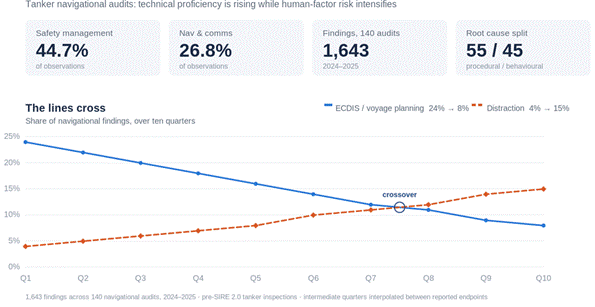
Capt. Daniele Badalucco is Chief HSQE Officer at Prevention at Sea, bringing over three decades of hands-on experience in vetting and Safety Management Systems to operators preparing for SIRE 2.0, RISQ, TMSA and DryBMS. Prevention at Sea is an LR-certified maritime compliance and technology firm, certified to ISO 9001, ISO 27001 and ISO 22301, and a member of the Dry Bulk Centre of Excellence. The figures cited are drawn from the Prevention at Sea database, including 140 navigational audits conducted in 2024 and 2025.